
2026 WUL Third Edition Rule Book
Introduction
Unless addressed below, the WUL shall apply the current rules of USA Ultimate.
Field Size
80 x 40, 20 yard end zones (120 yards total). Brick marks shall be set 20 yards from the goal line.
Equipment
Only official WUL discs shall be used during a game.
A minimum of two (2), but no more than four (4), replacement discs shall be placed near the sidelines of the playing field or near the backlines at least three (3) yards away from the playing field.
If the game disc is damaged at any point during the course of a game, or a live game disc goes out of bounds and is not retrievable within a reasonable amount of time, a replacement disc may be introduced by an observer.
Only observers and pre-identified authorized staff (ex: specified disc runners) may touch any replacement discs.
Observers
Observers are able to make the following active calls (i.e., empowered to rule immediately, without player request or initiation): (1) up/down (2) in/out of bounds (3) in/out of the endzone and (4) force outs. Observers shall signal the following active calls via whistle and/or hand signal: (5) offsides/false start and (6) time violations between points.
Observers shall make the following calls via instant referral: (1) travels, (2) picks, (3) double teams, and (4) stalls. An instant referral refers to when one of the aforementioned calls are made AND contested. In these instances, the observer will step in and make an immediate ruling, if able.
Observers shall implement the USAU player misconduct system and also implement the dangerous play review process (described below).
Game Length
A game shall consist of 4 quarters, 12 minutes per quarter. The end of each quarter must be indicated by a buzzer or a sound.
Flip
An observer shall administer a coin flip prior to the start of the game; the visiting team’s captains or coach shall make the call.
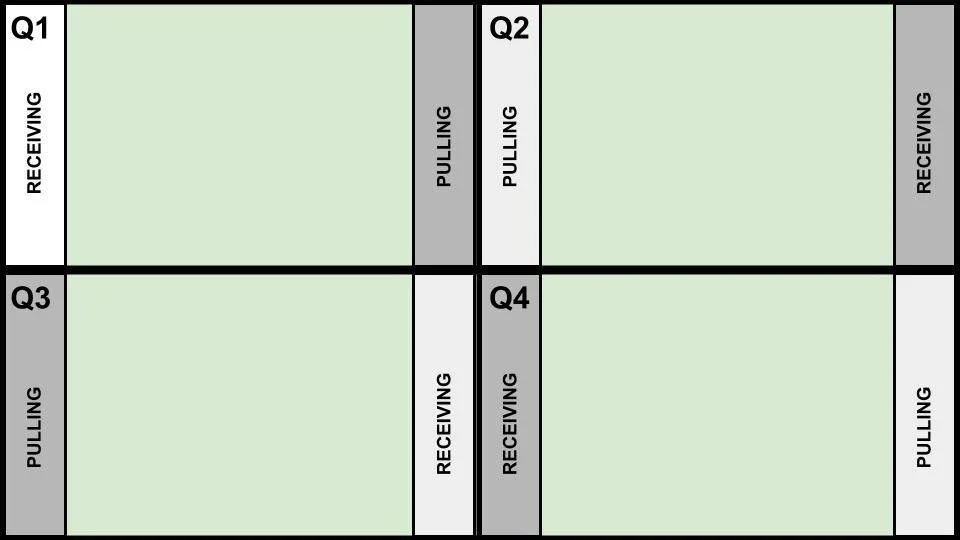
The winner shall choose whether to receive or throw the initial pull for Q1 & Q3 or Q2 & Q4, or the end zone they wish to initially defend. The other team shall get the remaining choice.
Teams shall defend the same end zone at the start of the first and second quarters (Q1 & Q2) and will switch for the third and fourth quarters (Q3 & Q4), as shown in the graphic below.
Time Prior to the Start of Each Quarter and Between Points
There is a maximum of 60 seconds at the start of each quarter and between points before play is to resume.
The receiving team has up to 40 seconds to signal readiness after the previous goal was scored, but must wait a minimum of 20 seconds to signal readiness. The pulling team must release the pull within 20 seconds of the receiving team signaling readiness.
Regulation Time Stoppages
The clock shall stop after every point and resume when the subsequent pull is released. The clock stops on all injury timeouts.
Other Time Stoppages
During the last two minutes of every quarter the clock shall stop when any call is made, when the disc becomes out-of-bounds, or when an in-bounds disc comes to rest completely in the end zone. Restart of the clock occurs when the disc is put back in play (via mark tap or offense ground check).
During the last two minutes of play in each quarter (and any overtime period), if the pull lands out of bounds, the clock is stopped as soon as the disc contacts the out of bounds area. If the pull rolls out of bounds, the clock stops as soon as the disc crosses out of bounds. Restart of the clock occurs when the disc is put back in play.
If time expires during or immediately after a call the team that has possession following the call shall have one possession. If a turnover occurs before the expiration of the clock, the team becoming offense shall have one possession.
Time Between Quarters
After play has stopped at the end of a quarter, there shall be a full 2 minutes after the first and third quarters, a minimum of 10 full minutes after the second quarter, and a full 5 minutes between the end of the fourth quarter and the start of Overtime.
Time Violations Between Points
There is no warning for time violations between points. If the receiving team exceeds the allotted time limit, they shall start with the disc at the “reverse brick mark,” i.e., 10 yards back in their end zone. If the pulling team exceeds the allotted time limit, the receiving team shall start with the disc at midfield. Teams may be issued technical violations in the event non-players or coaches are unable to vacate the field prior to signaling readiness or upon the pull. As specified in the USAU Misconduct System, more than two technical violations will result in a Misconduct Penalty.
If a time violation occurs, the pulling team has up to 20 seconds to check the disc into play. If the time limit is exceeded by either team, a player at the location where the disc is to be put into play may self-check the disc in without acknowledgement by the opposing team.
Offsides/False Start
There is no warning for offsides or false start. The penalties are the same as Time Violations Between Points.
If the receiving team is called for false start, they shall start with the disc at the “reverse brick mark,” i.e., 10 yards back in their end zone.
If the pulling team is offsides, the receiving team can start with the disc at midfield. However, the receiving team must signal they wish to accept an offsides penalty committed by the pulling team by mirroring the offsides signal, i.e., arms crossed overhead in an “X”, hands closed in a fist, wrists forward. If the receiving team chooses to reject the offsides penalty, they should not signal and play the pull as it lands.
Quarters Ends on Score or Loss of Possession
Once the clock expires during regulation time, play does not end until the conclusion of the current possession. That is, the team on offense at the expiration of the clock will maintain possession with the opportunity to end the quarter by scoring. However, if there is a turnover, the quarter is over.
Timeouts
Two timeouts per half, 60 seconds per timeout. In the event a team does not have a timeout, play stops and the marker shall resume the stall count with the number last uttered before the call plus three (3). If this results in a stall count of seven or above, this is a turnover.
Between points, a timeout may be called only by a coach.
During play, in addition to the player holding the disc, a timeout may be called by the teams’ coach, provided that their respective team is on offense and the disc is still in possession with their player (even if said player is in the middle of their throwing motion). Upon a change of possession in the central zone, the coach or the team that is now on offense can only call a timeout once a player on said team has physical possession of the disc.
If someone not designated calls a timeout, the first infraction is a warning, the second is a turnover.
No team may call a timeout during any possession after regulation time has expired. If a timeout is called after regulation time has expired, it is a turnover and the quarter shall be deemed over. No loss of timeout penalty shall be imposed.
If a timeout is called during play, both teams can substitute any and all players on the field. Furthermore, the stall count resets to one (1). Once the full 60 seconds have elapsed, the offense shall have up to 20 seconds to establish stationary positions, after which the defense has up to 20 seconds to check the disc into play.
Overtime
First Overtime - four (4) minutes of clock time. A coin flip shall be used again; the home team shall make the call. The winning team picks whether they shall receive or pull, or the end zone they wish to defend. The other team gets the remaining choice.
During the first two (2) minutes, the clock stops consistent with regulation time stoppages. During the last two (2) minutes, the clock shall stop consistent with the other time stoppages provision.
The First Overtime shall end once time expires. If time expires and the disc is in the air, the play shall continue until the result of the throw is determined. No subsequent throw shall be permitted.
If the game is still tied at the end of First Overtime, teams go to Second Overtime.
Second Overtime - sudden death. The teams shall switch who receives and the endzone position based on how play was initiated in the First Overtime. The first team to score shall end the game.
Each team is given one timeout per Overtime.
Stall Counting
Seven (7) second stall, counted by the marking player. Pre-stall time limits shall remain consistent with USAU rules.
Specific rules:
In the event of a contested stall in which the observer cannot make a ruling, the stall shall come in at 5.
In the event of a contested pick call in which the observer cannot make a ruling, the stall count shall resume at the count reached plus 1, no higher than 4.
In the event of an uncontested pick, uncontested offensive foul, or an offensive retracted call, the stall count shall resume at the stall reached plus one, but no higher than 6.
In the event of a contested foul or violation, or offsetting calls, the stall count shall resume at the count reached plus one, but no higher than 4.
In the event of a retracted defensive call, the stall shall resume at shall 1.
Picks
Players must be within 2 yards to call a pick.
Foul Calls
Players call their own fouls and violations consistent with the current USAU rules. However, players only have 15 seconds to reach an agreement on the call. Either player can go to the observer for a ruling during these 15 seconds. If there is no agreement or request for observer ruling, after 15 seconds the call stands as contested.
Movement After Calls (Not Applicable to Resolved Instant Referral Calls or Timeouts)
Upon recognition of a call necessitating a stoppage, players must stop where they are and echo the call with the appropriate hand signal. Players must remain still during the discussion and resolution of the call. Once the call is resolved, the defender closest to the resulting location of the disc taps either the ground or disc to initiate a four (4) second pre-check free movement.
The pre-check count shall then be vocalized by the nearest observer by stating “4-3-2-1-Disc In” and then the marker may either (1) re-initiate the stall as was last established before the call, or (2) initiate a new stall, in the event no stall count had begun. The observer, whose arm should already be extended upward during the discussion to signal call on the field, shall keep their arm extended until active play is resumed.
If a pre-check occurs when the disc is in possession of a player in the end zone, during the pre-check period the thrower may move to the spot on the end zone line where the disc is to be put into play. The thrower must establish a pivot at the appropriate spot on the end zone line and touch the disc to the ground. The thrower may not fake or set up their throw until after the observer says “disc in,” whether this occurs before or after the ground touch at the end zone line.
Players without the disc may move freely during this pre-check period, but the player with possession of the disc is not permitted to fake or otherwise set up their throw during this period. The disc then is checked in either by the (1) defense or an (2) offensive self-check, (i.e., ground tap).
In the event that the player in possession of the disc fakes or throws prior to the “disc in” call, the marker shall call violation. If the throw results in a turnover, the turnover shall stand. If the throw is caught, the disc is returned to the thrower, and the procedure is repeated. If the thrower repeats the violation, the result is a turnover. The disc shall be placed at the spot of the throwers’ pivot and play is resumed with a ground check.
See attached chart for specific usage:
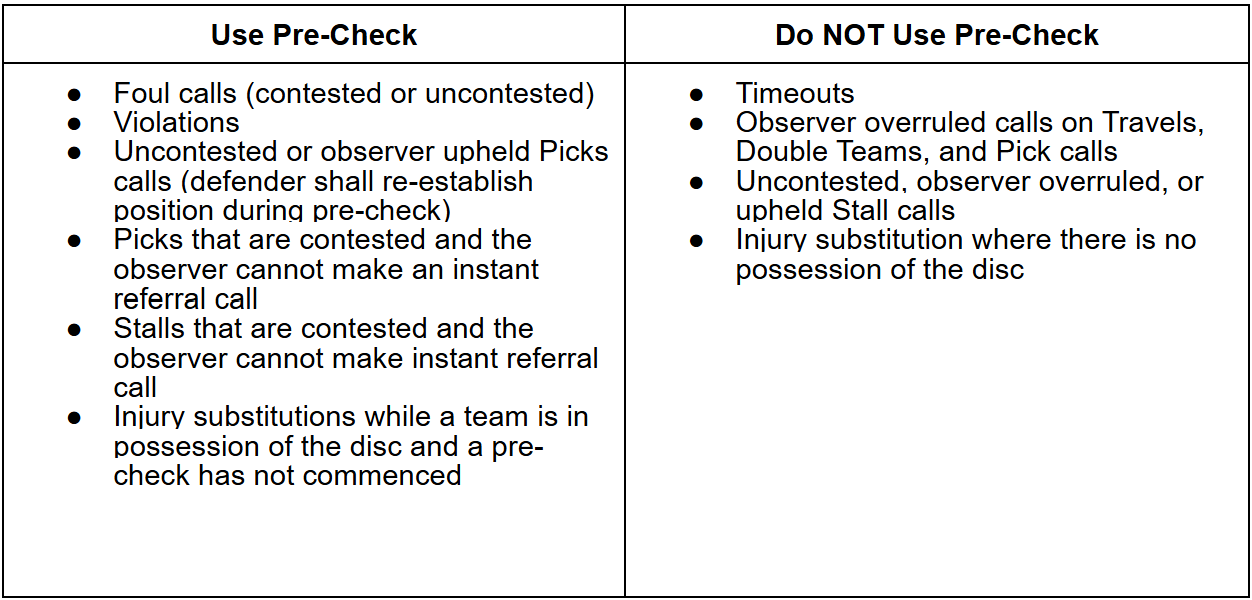
The check procedure set forth in USAU Rulebook Rule 9.D.3.a. shall not be used when pre-check applies. (See Rule 9.D.3.a. “The marker restarts play by loudly announcing ‘3-2-1,’ touching the disc in the thrower’s possession, and announcing ‘disc in.’”)
Player Overrule
Any coach, or player on the field, may make or reverse a call made by an observer if they believe it unfairly benefits their team. All players and coaches are expected to play with integrity, respect their opponents and observers, and uphold Spirit of the Game as set forth in section 2 of the USAU ruleset.
Rosters
Gameday roster: 22 players max, 17 players minimum. All WUL players must be 18+.
Uniforms
Numbers must be visible on the back and front of the jersey, and on the left side of the shorts. All players must wear the same team jersey. All players must wear the same team color and type of bottoms. All hats worn on the field must be team-branded hats. Refer to the team operations manual for additional requirements.
Dangerous Play Review Process
Any uncontested dangerous play will be assessed a yellow card. Observers and/or coaches must report all issued yellow cards and red cards, and all called dangerous plays, within 24 hours of each game.
In the event a coach wishes to challenge an issued yellow or red card or dangerous play call, the coach must file the challenge no later than 9:00 am on the Tuesday morning following the game at issue. Challenges shall be reviewed by the committee no later than the Wednesday evening following the game.
Additionally, any coach may submit a petition to report an instance of a non-issued card or request a finding of a dangerous play no later than 9:00 am on the Tuesday morning following the game at issue.
The WUL On-Field Player Safety Committee (described below) will track the number of cards issued, called dangerous plays, and petitions received for any player.
The committee must have a minimum of three (3) members present to rule on a petition or challenge. The committee shall accept or deny a petition or challenge by consensus vote and is responsible for executing the penalties stated below. Committee member(s) shall recuse themselves from any petition or challenge concerning a player/game that involves the team they are associated with as a member of the WUL Board or LDC.
If a player:
Accumulates two (2) yellow cards or dangerous plays over the course of a single game, the player shall be ejected for the remainder of that game. Additionally, the player must serve a one-game suspension.
Receives one (1) red card during the course of a game, the player shall be ejected for the remainder of that game. Additionally, the player must serve a one-game suspension.
Accumulates four (4) cards (yellow or red) and/or dangerous plays over a season, the player may be prohibited from competition for the rest of the season.
There will be an automatic review by the WUL On-Field Player Safety Committee of the circumstances prior to any season-long suspension being issued.
Accumulates three (3) petitions based on non-issued cards or non-called dangerous plays throughout a single season, regardless of the outcome of the petitions, the WUL On-Field Player Safety Committee shall notify the player’s coach and team general manager.
If a team:
Accumulates five (5) petitions for non-issued cards or non-called dangerous plays throughout a single season, regardless of the outcome of the petitions, the WUL On-Field Player Safety Committee shall notify the team’s coach and general manager.
The information related to player and team petition totals will not be made public to observers or to personnel from other teams; it will only be accessible to the WUL On-Field Player Safety Committee and shared with coaches and general managers as outlined above.
WUL On-Field Player Safety Committee includes:
Manisha Daryani (President of the Board, Bay Area Board Member)
Remy Schor (At-Large Board Member)
WUL Observers